

Have you ever paused while writing because you weren’t sure whether to spell the word as occasion or ocassion? These two spellings look almost identical, making it easy to choose the wrong one. However, only one is accepted in standard English.
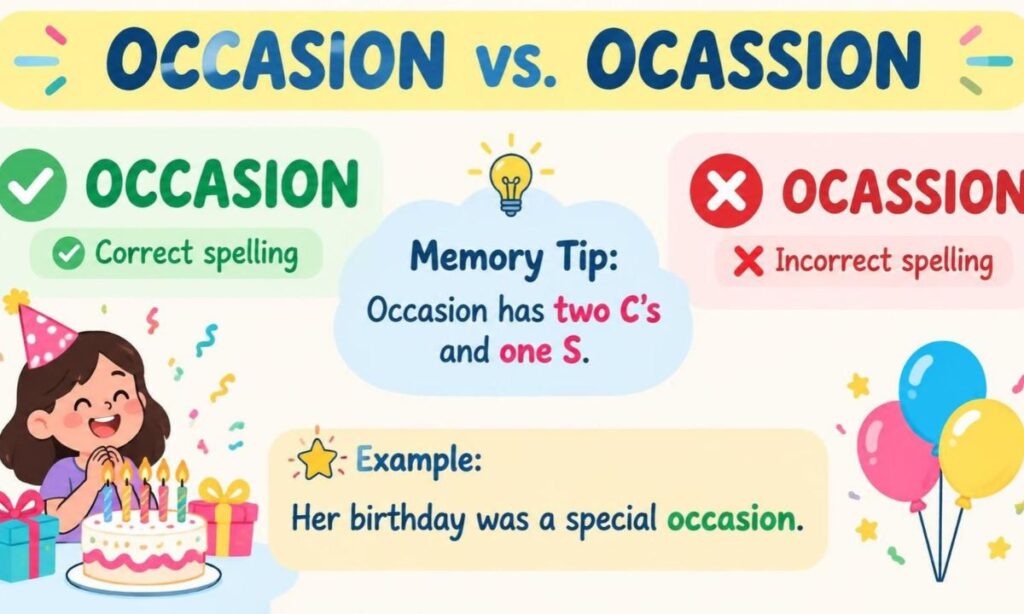
The correct spelling is occasion, with two C’s and one S. The spelling ocassion is a common misspelling. Whether you’re writing an email, a social media post, or an important document, using the correct spelling helps keep your writing clear and professional.
Understanding the difference is simple once you know how the word is spelled, what it means, and how to use it in everyday sentences.
Direct Answer: Occasion or Ocassion?
Occasion is the correct spelling in English. It means a particular event, situation, or special time. Ocassion is incorrect because it uses an extra S instead of the correct spelling pattern. Remember to write occasion with two C’s followed by one S.
Occasion vs. Ocassion: Spelling Comparison
The main difference between occasion and ocassion is the number of letters used.
The correct word contains two C’s and one S, while the incorrect version has only one C and two S’s.
| Word | Spelling status | Explanation |
| Occasion | Correct | Two C’s and one S |
| Ocassion | Incorrect | One C and two S’s |
Remember this simple spelling pattern:
- Occasion: O-C-C-A-S-I-O-N
- Ocassion: O-C-A-S-S-I-O-N
The word ocassion does not have a separate meaning in standard English.
It is simply a spelling mistake when someone intends to write occasion.
What Does Occasion Mean?
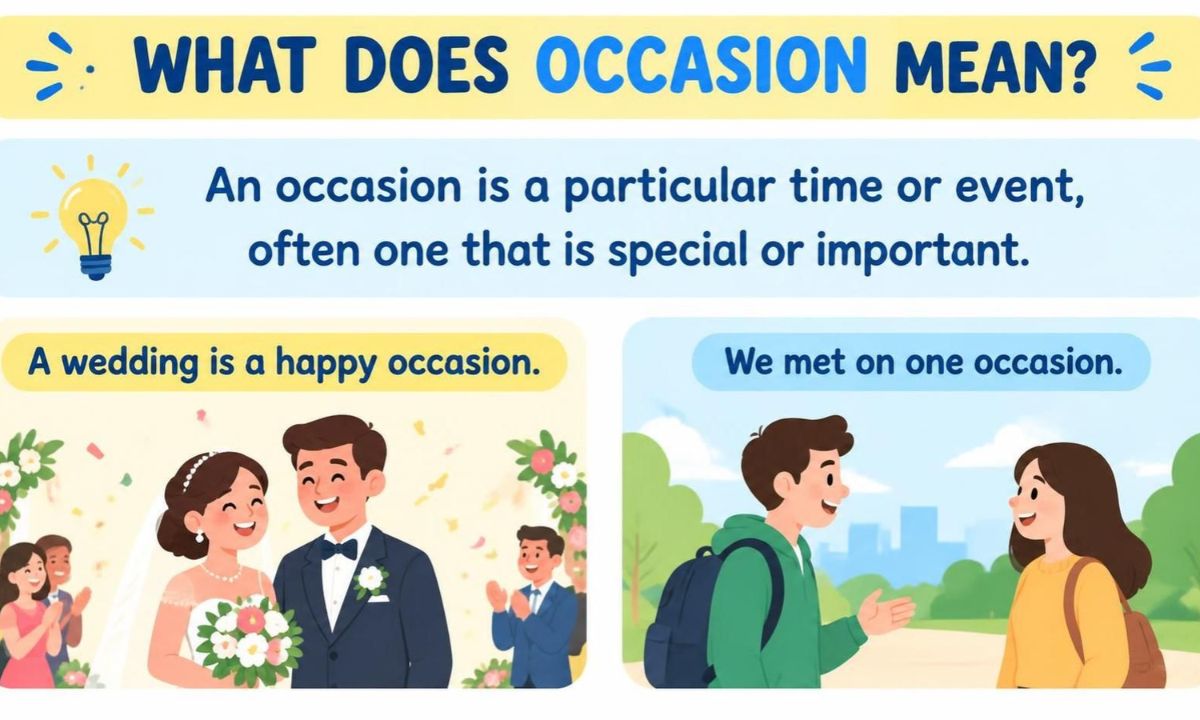
The word occasion is a noun that refers to a particular time, event, or situation.
It often describes something important, memorable, or worth celebrating.
According to Cambridge Dictionary, occasion can describe a particular time when something happens or a special or formal event.
English meaning – Cambridge Dictionary+1
Here are some common meanings:
- A special event: A celebration, ceremony, or important gathering.
- A particular time: A specific moment when something happens.
- An opportunity: A suitable chance to do something.
- A reason or cause: Something that gives a person a reason to act or respond.
Examples of Occasion in Everyday Sentences
Here are some examples showing how to use the correct spelling naturally:
- Her wedding was a beautiful occasion for the entire family.
- We usually buy new clothes for special occasions.
- This is a perfect occasion to celebrate your success.
- I have met him on several occasions.
- The graduation ceremony was an important occasion for everyone.
In each sentence, occasion refers to an event, time, or opportunity.
Why Is Ocassion Incorrect?
The spelling ocassion is incorrect because it does not follow the standard English spelling of the word.
It replaces the second C with an extra S.
The correct spelling has remained occasion in modern English.
Its historical roots can be traced through Old French to the Latin word occasionem.
Etymology, Origin & Meaning+1
One reason people make this mistake is that the word’s pronunciation does not clearly reveal how many C’s and S’s it contains.
When people write quickly, they may remember the sound but forget the correct letter pattern.
For example:
- Incorrect: We had a wonderful family ocassion.
- Correct: We had a wonderful family occasion.
The second sentence uses the accepted English spelling.
How to Remember the Correct Spelling of Occasion
Remembering the spelling becomes easier when you focus on its letter pattern instead of trying to memorize the entire word.
Here are some simple techniques.
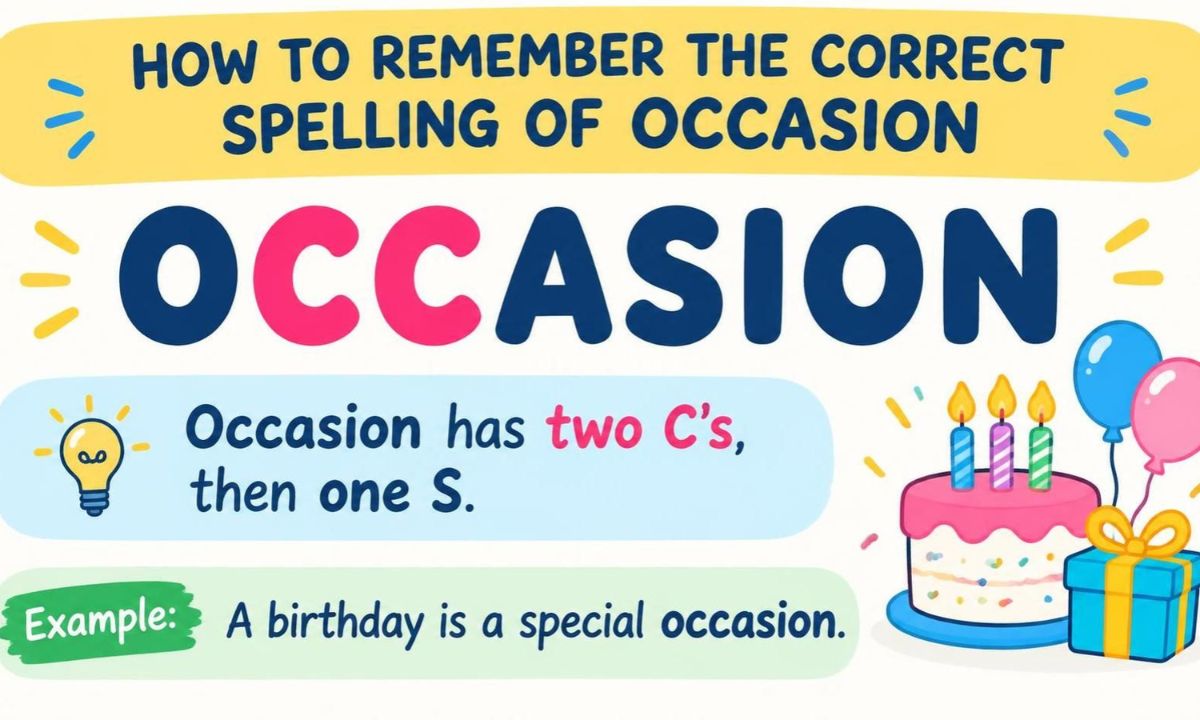
1. Remember Two C’s and One S
The easiest way to remember occasion is to focus on its consonants.
It contains:
- Two C’s together.
- One S after the letter A.
Think of it as OCC + ASION.
This simple pattern can help you avoid adding an unnecessary S.
2. Break the Word Into Smaller Parts
Divide the word into smaller sections to make it easier to remember.
Oc-ca-sion
Now look at the spelling carefully.
The first part contains two C’s, while the final part contains only one S.
Practicing this pattern a few times can help you remember the correct spelling.
3. Practice Writing It in Sentences
Writing the word in different sentences can improve your spelling memory.
Try these examples:
- It was a special occasion.
- What is the occasion?
- We celebrate important occasions together.
- I occasionally visit my grandparents.
Repeating the correct spelling in different contexts makes it easier to recognize and use.
Read Also : KYS Meaning in Text: What It Really Means in 2026
Occasion: Meaning, Pronunciation, and Word Forms
Understanding the pronunciation and related forms of occasion can also help you use it correctly.
How Do You Pronounce Occasion?
The word occasion is pronounced:
uh-KAY-zhuhn
Its American English pronunciation is represented by the IPA transcription /əˈkeɪ.ʒən/.
Pronunciation in English
The word has three syllables:
- Oc
- ca
- sion
The strongest emphasis falls on the second syllable.
Although the spelling contains two C’s and one S, the pronunciation does not make this letter pattern obvious.
What Are the Different Forms of Occasion?
The word occasion has several related forms.
Each has a slightly different grammatical function.
| Word | Part of speech | Meaning |
| Occasion | Noun | A particular event or time |
| Occasions | Plural noun | More than one event or time |
| Occasional | Adjective | Happening sometimes |
| Occasionally | Adverb | Happening from time to time |
| Occasioned | Verb | Caused or brought about |
| Occasioning | Verb | Causing something to happen |
Examples:
- Occasion: The birthday was a special occasion.
- Occasions: We attend family occasions every year.
- Occasional: He makes occasional visits to our office.
- Occasionally: I occasionally travel for work.
- Occasioned: The announcement occasioned a long discussion.
- Occasioning: His actions were occasioning unnecessary problems.
These related words follow their own spelling patterns.
Learning them together can help expand your vocabulary.
Common Phrases and Expressions With Occasion
The word occasion appears in several everyday English expressions.
Understanding these phrases will help you use it more naturally.
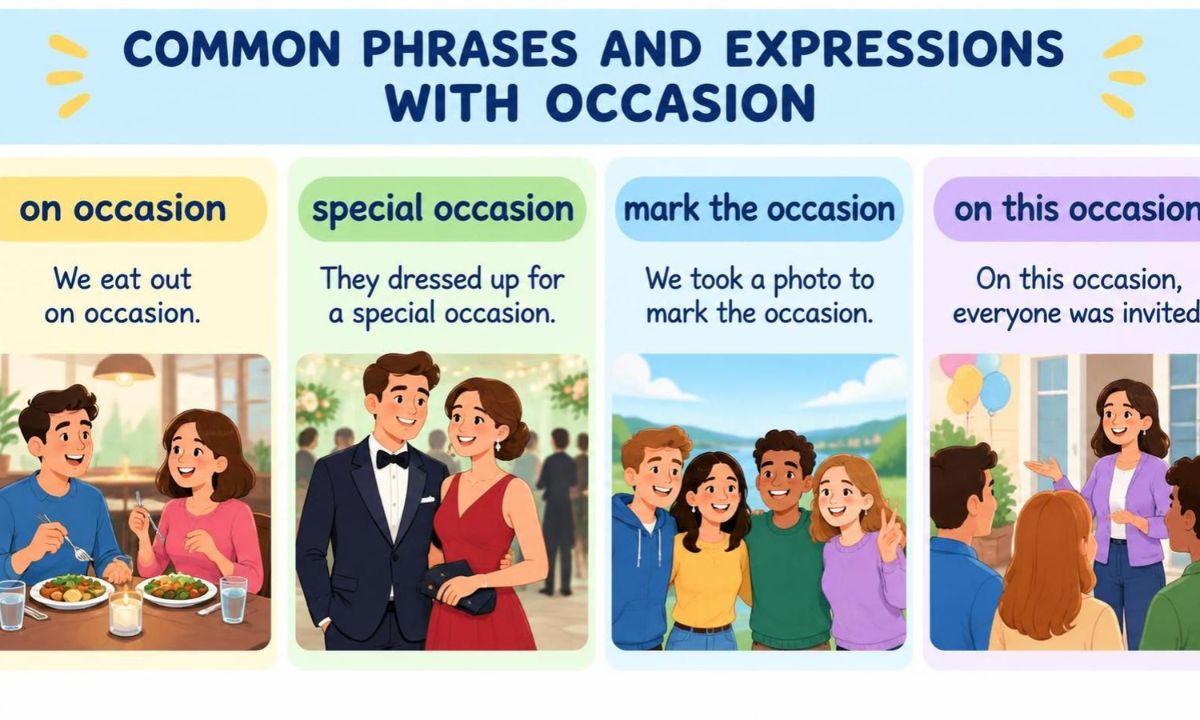
1. Special Occasion
This phrase describes an important or memorable event, such as a wedding, birthday, anniversary, or graduation.
Example: We booked a nice restaurant for the special occasion.
2. On Occasion
The phrase on occasion means sometimes or from time to time.
It describes something that happens occasionally rather than regularly.
Collins English Dictionary
Example: I enjoy going hiking on occasion.
3. Rise to the Occasion
This expression means responding successfully to a difficult situation or meeting an important challenge.
Example: The team rose to the occasion and completed the project before the deadline.
4. On This Occasion
This phrase refers to a particular event or specific time being discussed.
Example: On this occasion, everyone arrived before the meeting started.
5. Have Occasion to
This expression means having a reason or need to do something.
Example: I have never had occasion to visit that part of the country.
These expressions are useful in everyday conversations, professional writing, and formal communication.
Common Mistakes to Avoid When Using Occasion
Even though occasion is a common English word, people sometimes make spelling and usage mistakes.
Here are a few errors worth avoiding.
| Incorrect usage | Correct usage |
| Ocassion | Occasion |
| Occassion | Occasion |
| Ocassionally | Occasionally |
| Special ocassion | Special occasion |
| On special ocassions | On special occasions |
Notice that ocassionally is also incorrect.
The correct spelling is occasionally, which contains two C’s and two L’s, but only one S.
Is Occasion the Same as Opportunity?
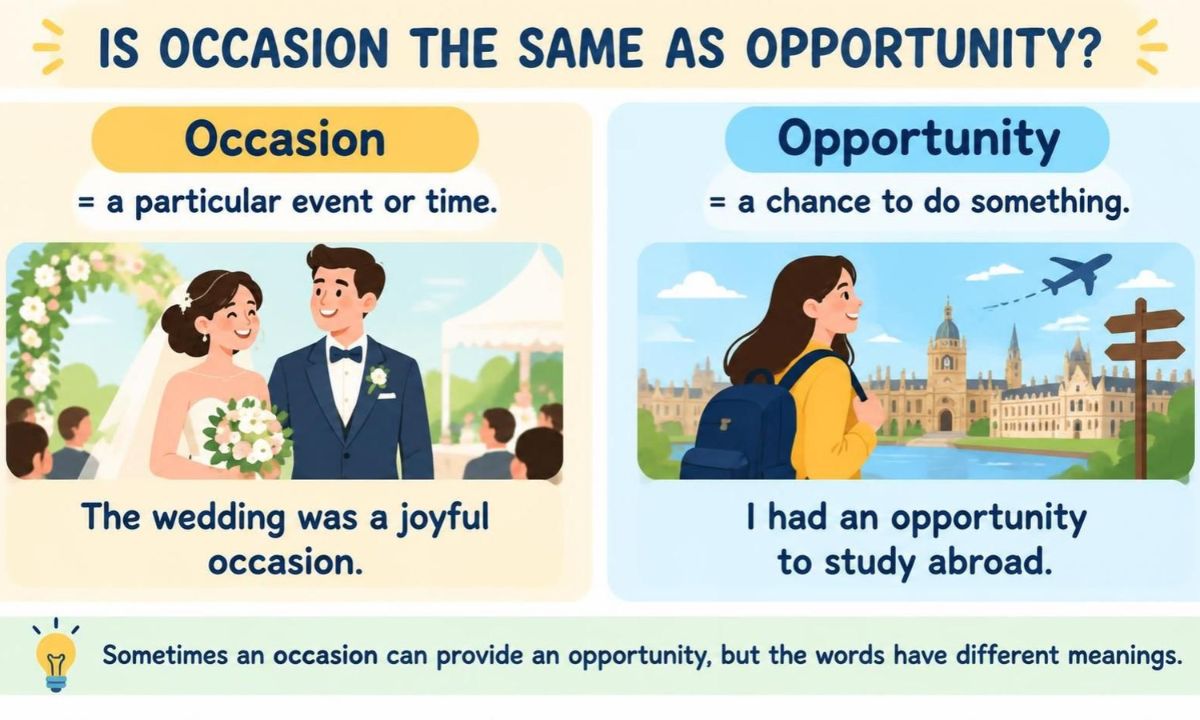
The words occasion and opportunity have similar meanings, but they are not always interchangeable.
An occasion usually refers to a particular event, time, or situation.
An opportunity specifically refers to a favorable chance to do something.
For example:
- Occasion: Her graduation was a memorable occasion.
- Opportunity: The new job gave her an opportunity to develop her skills.
Both words can refer to a favorable situation, but their meanings depend on the context.
Occasion vs. Ocassion: Quick Practice Test
Test your understanding with these simple spelling questions.
Choose the correct spelling in each sentence.
- Her birthday was a special (occasion / ocassion).
- We have met on several (occasions / ocassions).
- This is a wonderful (occasion / ocassion) to celebrate.
- I (occasionally / ocassionally) visit my old school.
- The wedding was an important (occasion / ocassion) for everyone.
Correct answers: 1. Occasion, 2. Occasions, 3. Occasion, 4. Occasionally, 5. Occasion.
Frequently Asked Questions
1. Is it occasion or ocassion?
Occasion is the correct spelling.
It contains two C’s and one S, while ocassion is a common spelling mistake.
2. Why do people misspell occasion as ocassion?
People often confuse the number of C’s and S’s because the pronunciation does not clearly show the spelling.
Remembering two C’s and one S can help prevent this mistake.
3. What is the plural of occasion?
The plural of occasion is occasions.
You simply add an S to the end of the word.
4. How do you pronounce occasion in American English?
Occasion is pronounced uh-KAY-zhuhn.
It has three syllables, with the strongest emphasis on the second syllable.
5. Is occasion a noun or a verb?
Occasion is primarily used as a noun to describe an event, time, or opportunity.
It can also function as a verb meaning to cause something to happen.
6. What is the difference between occasion and occasionally?
Occasion is a noun referring to an event, time, or opportunity.
Occasionally is an adverb meaning sometimes or from time to time.
7. What is another word for occasion?
Depending on the context, similar words include event, celebration, opportunity, moment, circumstance, and happening.
8. Is ocassion ever an acceptable spelling in English?
No.
Ocassion is not an accepted standard English spelling.
Use occasion whenever you want to refer to a particular event, time, or opportunity.
Conclusion
When comparing occasion vs. ocassion, the correct spelling is always occasion.
It contains two C’s and one S, while ocassion is an incorrect spelling.
Remember the simple rule: Two C’s, one S.
Whether you are writing about a birthday, wedding, celebration, or important moment, using occasion will keep your English spelling accurate and professional.
